How to Use Comic Videos AI: A Beginner’s Guide
Creating comic-style videos sounds exciting until you start thinking about scripts, visuals, animation, editing, and voiceovers. If you want to publish videos on YouTube Shorts or Facebook Reels, these steps can feel like a lot of work, especially when you are creating everything alone.
That is why AI video creation tools have become interesting to beginner creators. They may help simplify parts of the video-making process and give creators a starting point for turning an idea into visual content.
The Comic Videos AI Bundle is marketed around AI-powered comic video creation. But before deciding whether it fits your workflow, it is important to understand how to approach the tool, what to check before buying, and how to create videos that people actually want to watch.
In this guide, you will learn how to use Comic Videos AI in a practical workflow, from choosing a story idea to preparing a video for publication. You will also find realistic examples, advantages and limitations, alternative methods, and buying tips.
The goal is simple: help you decide whether this approach makes sense for your content goals without relying on unrealistic promises about automation or guaranteed results.
Quick Product Overview
| Category | Details |
|---|---|
| Product Name | Comic Videos AI Bundle |
| Product Category | AI comic video creation and digital content tools |
| Best For | Beginners, faceless video creators, storytellers, and social media marketers |
| Main Purpose | Help users explore AI-assisted comic-style video creation |
| Price Range | Check the current official offer before purchasing |
| Key Benefit | Potentially simplify parts of the comic video creation workflow |
| Platforms to Consider | YouTube Shorts, Facebook Reels, Instagram Reels, and other compatible video platforms |
| Experience Level | Best evaluated by beginners and creators comparing AI video workflows |
Important: The exact tools, features, usage limits, commercial rights, and included upgrades should be confirmed on the current sales page before purchasing.
What Is Comic Videos AI?
Comic Videos AI is a name associated with an AI-assisted comic video creation offer. The Comic Videos AI Bundle is intended for people interested in making visual content without necessarily building every scene manually.
Traditional comic video production can involve several separate tasks:
- Developing a story idea.
- Writing dialogue or narration.
- Creating characters and backgrounds.
- Arranging scenes in a logical order.
- Adding movement, transitions, or effects.
- Editing the final video.
- Preparing the video for social media.
Depending on the software and workflow, AI tools may help with some of these tasks. However, the level of automation varies, so do not assume that every step happens automatically.
For a beginner, the most useful approach is to start with a short, simple story and learn how the available tools fit together.
How to Use Comic Videos AI: 7 Practical Steps
The following workflow explains how to approach comic video creation. Exact buttons and features may differ from the current version of the product, so use the instructions provided inside the tool once you have access.
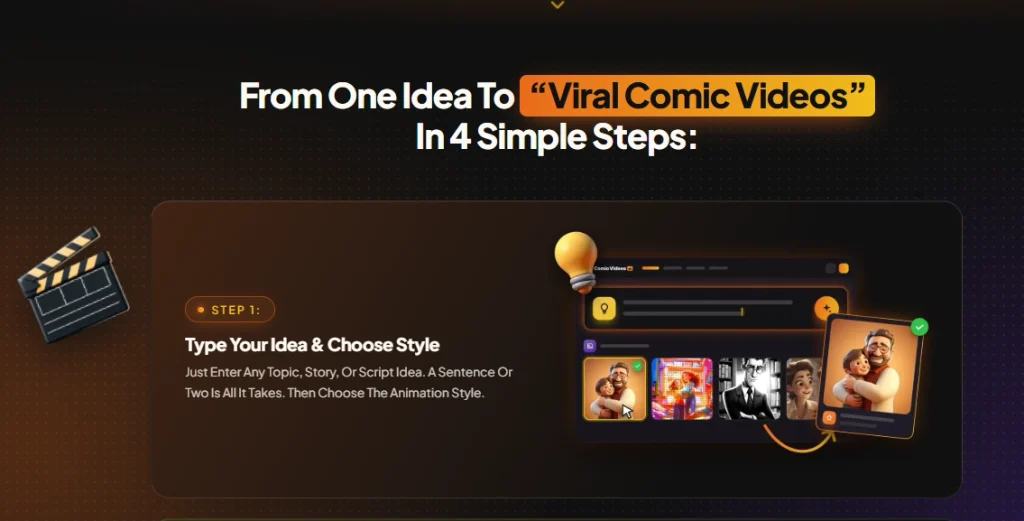
Step 1: Choose Your Video Idea
Start with one clear idea instead of trying to create a long episode.
For example, you could make:
- A funny conversation between two friends.
- A short moral story.
- A surprising ending to a fictional mystery.
- A relatable moment from everyday life.
- A simple educational story for beginners.
Think about your audience before choosing the subject. A humorous story may suit entertainment viewers, while a short lesson may work better for educational content.
A good first project should be easy to understand and possible to explain in a few sentences.
Step 2: Write a Short Script
A comic video needs a beginning, a middle, and an ending. Even a 30-second video benefits from a clear structure.
Here is a simple example:
Title: The Clever Cat
Scene 1: A cat sees a fishbowl on a table.
Scene 2: The cat tries to reach the fish but keeps slipping.
Scene 3: The cat pushes a small box toward the table and climbs onto it.
Ending: Just as the cat reaches the bowl, its owner walks into the room. The cat suddenly pretends to be asleep.
This idea has a clear visual action and a small surprise at the end. You can develop it into dialogue, narration, or captions depending on your chosen production method.
Keep the dialogue short. Viewers watching short-form videos may leave if the story takes too long to get moving.
Step 3: Explore the Available Creation Tools
Once you have access to Comic Videos AI, review its dashboard and available creation options.
Look for the functions needed for your chosen project. Depending on what the bundle actually includes, these might involve story creation, visual generation, animation, voice, or editing.
Do not assume a feature is included just because it is common in other AI video products. Confirm what is available in your account.
If the tool offers a guided workflow, begin there. Follow the instructions to create a small test project before attempting a complicated video.
The goal is to understand the process first, not to create a perfect video on your first attempt.
Step 4: Prepare Your Characters and Scenes
Comic storytelling depends on visuals that viewers can understand quickly.
For the clever cat story, you might need:
- A recognizable cat character.
- A room with a table and fishbowl.
- A box that the cat can climb.
- A final scene showing the owner entering the room.
Try to keep the character’s appearance consistent from one scene to the next. If the cat looks completely different in every scene, the video may feel disconnected.
If your chosen tool cannot maintain consistent characters, you may need to reuse approved images or make manual adjustments with another editor.
Also, use original or properly licensed visual assets. A familiar cartoon character or a popular comic image may be protected by copyright.
Step 5: Add Movement, Voice, or Captions
Static comic images can tell a story, but movement and sound may make the result more engaging.
Depending on your workflow, you could add:
- Simple zooms and pans.
- Scene transitions.
- Narration or character dialogue.
- Background music.
- On-screen captions.
- Sound effects that support the action.
Keep these elements purposeful. A dramatic sound effect does not improve a scene if it distracts viewers from the story.
If you use AI-generated narration, listen to the full recording before publishing. Check pronunciation, pacing, and whether the voice matches the mood.
Captions are especially helpful for viewers who watch videos with the sound turned off.
Step 6: Edit and Review the Video
Before exporting, watch the entire video from beginning to end.
Check these points:
- Does the story make sense without extra explanation?
- Are any words cut off?
- Are captions readable on a phone?
- Do scenes change at the right time?
- Are character appearances consistent?
- Is the sound balanced?
- Does the ending feel complete?
Remove unnecessary pauses and repeated scenes. If a joke needs too much explanation, simplify it.
For a short-form video, a focused story is often more useful than adding many visual effects.
Step 7: Export and Prepare for Publication
When the video is ready, choose an export format and resolution supported by your intended platform.
For YouTube Shorts and Facebook Reels, a vertical video layout is often a sensible starting point. Check each platform’s current specifications before exporting.
Then prepare a relevant title, description, and thumbnail or cover image where applicable.
Before publishing, confirm that you have the rights to use the visuals, music, voices, and other assets. Also review the platform’s current rules on AI-generated content and disclosure where relevant.
Finally, track how viewers respond. Watch time, audience retention, comments, and shares can help you decide what to improve in the next video.
How to Create Better Comic Videos With AI
Learning the software is only part of the process. The quality of your story, editing, and presentation also matters.
Start With One Main Character
Too many characters can make a short video confusing. Begin with one or two characters who have clear roles.
For example, a clever cat and a surprised owner are easier to follow than a scene containing five characters with different motivations.
Give Viewers a Reason to Keep Watching
Your opening should quickly establish a question, problem, or interesting situation.
Instead of starting with a long introduction, show the cat reaching for the fishbowl immediately. Viewers can understand the situation and become curious about what happens next.
Keep the Visual Style Consistent
Use a similar art style, color palette, and character design throughout the video.
A consistent appearance helps viewers recognize your characters and makes a series feel more professional.
Use Music Carefully
Music can support a funny, dramatic, or emotional scene, but it should not overpower dialogue or narration.
Choose audio you have permission to use commercially when you plan to monetize your content.
Improve One Thing at a Time
After publishing your first few videos, choose one improvement for your next project.
Perhaps the opening needs to be faster, the captions need to be larger, or the ending needs a stronger payoff. Small improvements can make your workflow easier to manage.
Comic Videos AI Bundle: What Should You Check?
Before buying the Comic Videos AI Bundle, look beyond the product name. A bundle can contain multiple tools, optional upgrades, or separate services, and these may have different costs and conditions.
Review the following details on the current official offer.
Included Features
Check the exact features included in the main purchase. Find out whether comic creation, animation, narration, editing, and exporting are included or require separate tools.
One-Time Cost or Recurring Payments
A headline price does not always tell you the total cost. Confirm whether the offer is a one-time payment, a subscription, or a combination of both.
Look for optional upgrades at checkout and check whether they are required for the workflow you want.
Usage Limits
Some AI tools have limits on generation credits, video length, exports, or processing. If you plan to publish videos regularly, these details may matter more than the initial price.
Commercial-Use Rights
If you intend to monetize your videos, read the license terms carefully. Confirm whether you can use the generated content commercially and whether any restrictions apply to the included assets.
Refund Policy and Support
Check the refund window, conditions, and support options before completing your order. Save a copy of the terms that apply to your purchase.
These checks help you compare the bundle with alternatives based on what you will actually receive.
Pros and Cons of Comic Videos AI
A balanced decision should consider both the potential benefits of an AI-assisted workflow and the limitations that may affect your results.
Potential Pros
- A useful starting point for beginners: A guided workflow may help new creators understand the steps involved in making comic videos.
- Less manual work in some areas: Depending on the included features, AI assistance may reduce time spent on selected production tasks.
- Suitable for testing content ideas: Short comic stories are a practical way to experiment with different topics and formats.
- Useful for faceless content projects: Comic storytelling can be produced without appearing on camera.
- Potentially helpful for repeatable workflows: A consistent process can make it easier to plan a series of videos.
Potential Cons
- The actual workflow needs testing: The product’s usefulness depends on its current features and how well they match your needs.
- Results may require editing: Generated visuals, dialogue, and timing may need corrections before publication.
- Consistency can be challenging: Characters, backgrounds, and visual styles may not remain identical across scenes.
- Extra costs may apply: Optional upgrades, usage limits, or third-party tools can affect the total budget.
- No guarantee of audience growth: Using an AI tool does not guarantee views, subscribers, or monetization.
- Licensing must be checked: You are responsible for understanding the terms for generated content and any third-party assets you use.
Who Should Buy Comic Videos AI?
The bundle may be worth investigating if you fall into one of these groups.
Faceless YouTube Creators
If you prefer not to show your face, comic storytelling offers one possible format for building a recognizable channel. You can focus on the story, characters, and editing instead of recording yourself on camera.
YouTube Shorts and Facebook Reels Creators
Creators who want to experiment with short stories may find an AI-assisted workflow useful, provided the tool supports their required output and the resulting videos meet platform specifications.
Affiliate and Digital Marketers
Marketers can explore comic-style videos as a way to explain a problem, introduce a concept, or create educational content. Promotional content should be accurate, and affiliate relationships should be disclosed where required.
Storytellers and Comic Creators
If you already have story ideas but struggle with the production process, AI-assisted tools may help you test how those stories look in video form.
Beginners With Limited Editing Experience
A beginner may benefit from a guided workflow, but it is still important to learn basic storytelling, editing, and publishing skills.
Who Should Avoid This Product?
Comic Videos AI may not be the right fit for everyone.
Consider other options if:
- You need advanced animation with precise control over every movement.
- You require guaranteed character consistency across a large series.
- You already have a professional workflow that meets your needs.
- You cannot afford the purchase without relying on future earnings.
- The features you need are available only through expensive upgrades.
- You have not confirmed the commercial-use rights or output limitations.
If your main goal is simply to add captions, trim clips, or assemble existing footage, a conventional video editor may be sufficient.
Comic Videos AI vs Alternative Video Creation Methods
There is no single best tool for every creator. The right choice depends on your budget, experience, preferred style, and the amount of control you need.
| Option | Main Advantage | Main Limitation | Best For |
|---|---|---|---|
| Comic Videos AI Bundle | May provide a focused comic video workflow | Exact features and costs must be verified | Creators interested in AI-assisted comic production |
| General AI Video Generators | Can support a variety of visual video styles | May require extra work to achieve a comic look | Creators experimenting with different video concepts |
| Traditional Video Editors | Offer direct control over timing, captions, and transitions | Often require you to prepare or source the visuals | Creators who already have images or footage |
| Manual Comic Animation | Allows detailed creative control | Can require more time and skill | Artists and experienced animators |
| AI Image Tools Plus an Editor | Flexible approach to custom scenes and storytelling | Multiple tools may be needed | Creators who want more control over each step |
Which Option Is Best for You?
Choose Comic Videos AI if its verified features match your desired workflow and the total cost is reasonable.
Choose a general AI video generator if you want to experiment with several visual styles rather than focus on comic storytelling.
Choose a traditional editor if you already have your visuals and mainly need to assemble them into a finished video.
Choose manual animation if you need detailed control over character movement and have the time or skills to produce it.
Before committing, test the simplest workflow that can produce the kind of video you want.
Is Comic Videos AI Worth Buying?
Whether the Comic Videos AI Bundle is worth buying depends on what it includes, how often you will use it, and how much time it saves you.
A tool that makes your first video easier may be valuable to a beginner. However, a tool that requires several additional purchases or extensive manual editing may not offer the same value.
Consider these questions:
- Does the bundle include the features I actually need?
- Can I produce the style of comic video I have in mind?
- Are the export options suitable for my target platforms?
- Are there generation limits or recurring fees?
- Can I use the output commercially under the license terms?
- Is the refund policy clear?
- Would a free or lower-cost alternative be enough?
If you can answer these questions confidently and the price fits your budget, the product may be worth testing. If important details remain unclear, wait until you have verified them.
Buying Mistakes to Avoid
Buying Because of an Income Promise
Do not purchase a tool simply because a promotion suggests you will quickly earn money from videos. Results depend on content quality, audience demand, consistency, and other factors.
Ignoring the Full Cost
Review the checkout page carefully. Optional upgrades can change the total amount you spend.
Assuming Every Feature Is Included
Read the included-feature list and license terms. Do not assume that a feature shown in a promotional video is part of the base bundle.
Skipping the First Test Project
Before building an entire channel around a tool, create one short video and evaluate the result. A small test can reveal limitations early.
Forgetting Copyright and Platform Rules
Use original or properly licensed assets, check the applicable commercial-use terms, and follow the latest rules of the platform where you publish.
Tips for Using Comic Videos AI for YouTube Shorts and Facebook Reels
If short-form social media is your main goal, keep your production process focused.
Use a vertical format. Plan your visuals for a phone screen, with important characters and text kept away from interface overlays.
Make the opening clear. Show the central problem or interesting moment early rather than spending too much time introducing the story.
Keep captions readable. Use short lines, clear contrast, and sensible placement.
Give the story an ending. A surprising, funny, or satisfying final moment can make a short video feel complete.
Create related videos. If viewers respond well to a character or theme, consider developing another original story around it.
Review performance. Use available audience-retention and engagement data to understand where viewers lose interest.
Remember that the best format is the one that serves your story. Do not add animation or effects just because the software allows them.
Frequently Asked Questions
1. How do I use Comic Videos AI?
Start by choosing a short story idea, preparing a simple script, and exploring the creation options available in your account. Create a test video, review the visuals and audio, edit any problems, and export it in a format suitable for your target platform.
2. Is Comic Videos AI suitable for beginners?
It may suit beginners who want to explore AI-assisted comic video production. However, ease of use depends on the actual interface, available guidance, and features included in the bundle. Confirm these details before purchasing.
3. Can I use Comic Videos AI to create YouTube Shorts?
You can explore comic-style videos as a format for YouTube Shorts, but first verify that your workflow can export the required video format and dimensions. You should also review YouTube’s current monetization and content policies.
4. Can I use Comic Videos AI for Facebook Reels?
Comic-style storytelling can be adapted for Facebook Reels if the finished video meets the platform’s technical requirements and content rules. Check the tool’s export options and the applicable license terms.
5. Do I need video editing experience?
You may not need advanced editing skills to start, but basic editing knowledge is useful. You should be able to review timing, correct captions, check audio, and remove mistakes before publishing.
6. Can I monetize videos created with Comic Videos AI?
Monetization depends on the tool’s license, the rights to the assets you use, and the policies of the platform where you publish. Confirm commercial-use permission and make sure your videos provide original value rather than relying on repetitive or low-effort output.
7. Is Comic Videos AI free?
Do not assume it is free. Check the current official offer for the purchase price, any recurring charges, optional upgrades, and usage limits before making a decision.
8. What should I do if Comic Videos AI does not produce the result I want?
Try a simpler script, reduce the number of scenes, and review the available settings. You can also use a separate editor or another compatible tool to improve the result. If a required feature is missing, compare alternatives before spending more money.
Final Verdict: Should You Try Comic Videos AI?
Comic video creation can be an interesting way to tell short stories, share educational ideas, or experiment with faceless social media content. An AI-assisted workflow may reduce some production work, but the quality of the final video still depends on the story, visual choices, editing, and audience fit.
The Comic Videos AI Bundle may be worth considering if you want to explore this format and its verified features match your needs. Before buying, confirm the current price, included tools, usage limits, commercial-use rights, and refund terms.
If you are new to video creation, begin with one simple project. Make a short story, check the result on a phone screen, and learn from the response before committing to a large production schedule.
My recommendation is to make the decision based on the workflow and terms you can verify, not on promises of effortless content or guaranteed earnings.
If the bundle offers the tools you need at a price you can comfortably afford, it may be a useful addition to your creative process. If not, a simpler editor or a combination of lower-cost tools may be the better choice.